
When trading a futures CFD, it is easy to focus on spreads, leverage, charts, and entry points. Yet another factor can become important during periods of sharp market movement: price limits in the underlying futures market.
Price limits are exchange mechanisms designed to restrict how far the price of certain futures contracts can move within a defined trading session. For CFD traders, understanding these limits is useful because futures CFDs derive their pricing from futures based markets. When the underlying market approaches or reaches a price limit, liquidity, volatility, spreads, and order execution can all behave differently.
For anyone considering CFD futures, knowing how these mechanisms work can help create more realistic expectations and improve risk management.
What Is a Futures CFD?
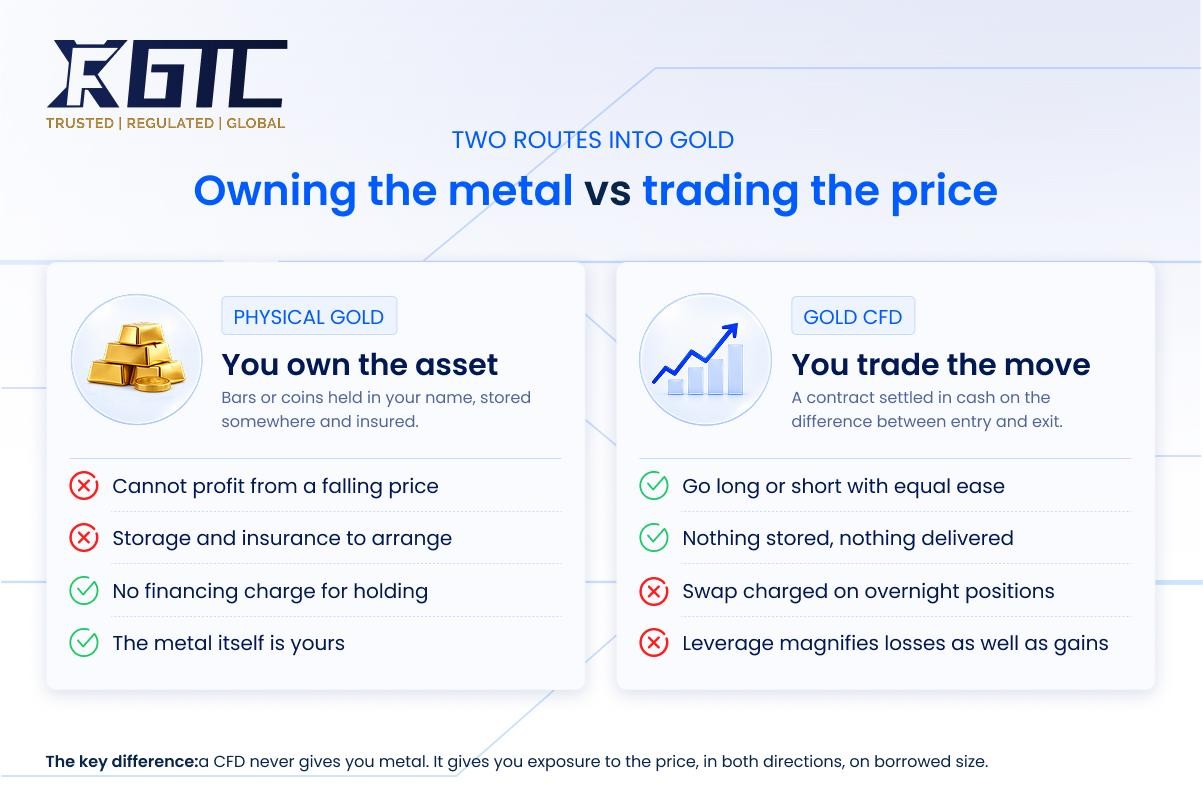
A futures CFD is a derivative that allows traders to speculate on price movements associated with futures markets without owning the underlying futures contract or taking physical delivery. Traders can generally take either a long or short position depending on their market expectations.
This differs from directly trading an exchange traded futures contract. With a futures CFD, the trader enters into a contract with the CFD provider, while the instrument references the relevant futures market. GTCFX describes its futures CFDs as instruments that provide exposure to major global futures markets without requiring physical delivery.
This structure can make futures based markets more accessible, but it does not remove the market characteristics of the underlying instrument. Events affecting the reference futures market can still influence CFD pricing and trading conditions.
What Are Price Limits in Futures Markets?
A price limit is a predefined threshold that restricts how far the price of certain futures contracts can move during a particular trading session. The exact methodology varies between exchanges and individual contracts.
For example, an exchange may establish an upper and lower price boundary relative to a reference price. If the market reaches one of those boundaries, trading may be restricted, paused, or subject to specific exchange procedures.
The purpose is generally to give the market time to absorb extreme buying or selling pressure. Price limits can become particularly relevant when markets react to unexpected economic data, geopolitical developments, supply disruptions, weather events, or other major news.
However, a price limit should not be interpreted as a guarantee that the market cannot experience further price risk. When trading conditions change or a new session begins, the permitted price range may also change.
Why Do Price Limits Matter for Futures CFD Trading?
The most important point for CFD traders is that an underlying futures price limit can affect the market environment surrounding a futures CFD.
Suppose an underlying futures contract experiences an exceptionally strong move and approaches its permitted price boundary. Trading activity may become less balanced, and available liquidity can change. As a result, CFD traders may encounter wider spreads, reduced liquidity, delayed execution, or differences between the requested price and the eventual execution price.
The precise response depends on the CFD provider, the underlying market, liquidity conditions, and applicable product terms. A price limit on an exchange therefore should not automatically be assumed to mean that a CFD will be frozen at exactly the same level.
This distinction is important because CFD pricing is determined according to the provider’s pricing and execution arrangements rather than simply copying every exchange mechanism one for one.
Can a Futures CFD Keep Moving When the Underlying Market Is Limited?
This is one of the questions traders often overlook.
The answer depends on the specific futures market and the CFD provider’s pricing arrangements. If the underlying futures market is subject to a trading restriction, the liquidity available to support CFD pricing may also become limited. In some circumstances, CFD trading conditions can be adjusted, suspended, or otherwise affected when reliable underlying pricing is unavailable.
GTCFX’s risk disclosure notes that trading conditions can be affected by market gaps, reduced liquidity, platform delays, and situations where an underlying market becomes unavailable or pricing becomes unreliable.
Therefore, traders should check the product specifications and applicable client agreement rather than assuming that a futures CFD behaves exactly like the exchange traded futures contract behind it.
Price Limits, Gaps, and Slippage
Price limits are particularly relevant when considering market gaps.
A market can move substantially between trading sessions or after a significant news event. If there is insufficient liquidity at intermediate price levels, an order may not be executed at the price a trader expected.
This is known as slippage. GTCFX explains that market, stop, take profit, and stop loss orders may execute at different prices when market conditions change rapidly or when an executable price is unavailable.
For CFD futures traders, this means that placing a stop loss should not be treated as an absolute guarantee of the maximum possible loss. During exceptionally volatile conditions, execution can occur at a different price from the requested level.
How Should Traders Manage the Risk?
Understanding the underlying market should come before choosing a trading strategy.
First, check the specifications of the futures based CFD you intend to trade. Trading hours, contract details, spreads, margin requirements, and other conditions can vary between instruments.
Second, monitor major economic and market events that could trigger sudden price movements. A futures CFD connected to commodities, indices, or other markets may respond rapidly to developments affecting its underlying sector.
Third, avoid relying solely on leverage to determine position size. Leverage can increase market exposure while requiring less initial margin, but it also magnifies potential losses. GTCFX specifically warns that leveraged CFDs can result in rapid and substantial losses.
Finally, understand the execution policy of your CFD provider. Knowing what happens when liquidity falls, the underlying market becomes unavailable, or extreme volatility occurs can be just as important as understanding the chart itself.
Choosing a Futures CFD Trading Environment
A suitable trading environment should provide clear information about the instruments available, pricing, execution, trading conditions, and associated risks.
GTCFX offers futures CFDs across multiple futures markets and states that its platform supports flexible leverage, competitive spreads, and multiple trading platforms including MT4, MT5, and GTCFX Go.
For traders comparing CFD futures providers, however, headline figures should not be the only consideration. It is equally important to review product specifications, applicable jurisdictional restrictions, execution conditions, and risk disclosures before opening a position.
A More Practical View of Futures CFD Risk
Price limits are only one part of the futures trading environment, but they illustrate an important principle: a CFD does not exist independently of the market it references.
When volatility increases, the relationship between price movement, liquidity, margin, spreads, and execution becomes more important. A trader who understands these factors is better positioned to interpret unusual market conditions and avoid making assumptions based only on normal trading behavior.
For this reason, learning how the underlying futures market operates can be valuable even when the trading instrument is a CFD.
Final Thoughts for CFD Futures Traders
Futures CFDs provide a way to speculate on futures based price movements without taking ownership or physical delivery of the underlying asset. However, the convenience of a CFD does not eliminate the market dynamics of the underlying futures market.
Price limits, liquidity changes, market gaps, and execution conditions can all influence the trading experience. By understanding these factors before entering a position, traders can make more informed decisions about leverage, position sizing, and risk management.
For anyone exploring a futures CFD, the goal should not simply be to identify where the market might move next. It should also be to understand what could happen when the market moves faster than expected.

